In the Headphones: What an Audio Describer Actually Sees
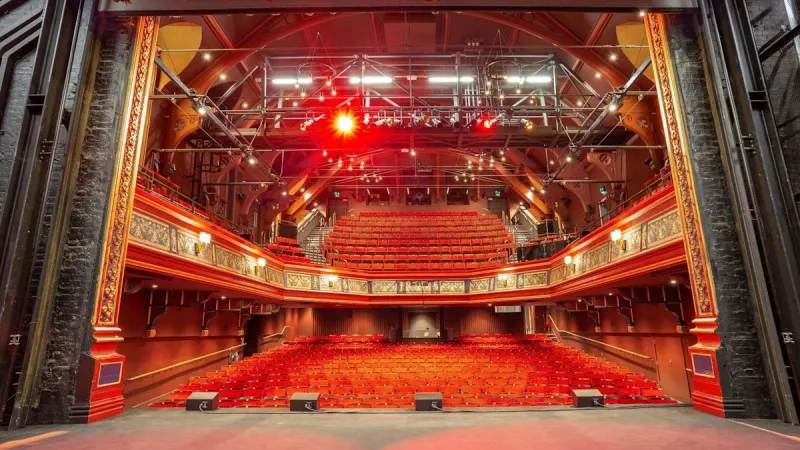
Photo: theatre headset audio description live performance accessibility, via s.yimg.com
There is a woman in the circle who has watched this production eleven times and still has not seen it properly. She has seen the cast, obviously — she has sat through more rehearsals than some of the swings — but her attention is on the gaps. Where the dialogue stops. Where the music swells. Where a character crosses the stage in silence and something needs to be said about it, quickly, before the next line lands.
Her name is Ruth, and she is an audio describer. On access nights, her voice is the one in the headsets.
The script that isn't a script
Audio description is not narration. It is not a commentary track, and it is emphatically not somebody talking over the actors. It is a second script, written specifically to slot into the pauses a show already contains.
Ruth starts with the text — the play, the libretto, the running order — and then throws most of it away. 'The script tells you what is said. It tells you almost nothing about what is happening,' she says. 'You have to build the other half.'
The build happens in the room. Ruth attends rehearsals, usually more than one, and then a preview or a run-through, timing every description against the actual production. A line that reads as eight seconds on the page can be three seconds in performance once the director has cut a pause, and a description that overruns by two seconds will trample the first words of the next speech.
So the script ends up full of numbers. Timecodes, breath marks, arrows. Professional describers talk about 'the gaps' the way sound designers talk about the mix.
Eleven viewings and a list of colours
Ask what she actually writes down and the answer is unexpectedly specific.
Costume colours, because a director has chosen them for a reason and a partially sighted audience is entitled to know that the sisters are in matching grey while the outsider is in red. Entrances and exits, because knowing who has walked on is the difference between following a scene and losing it. Physical comedy, because a great deal of British stage humour dies silently — a raised eyebrow, a dropped cup, a man failing to sit down — and none of it survives without a description.
Set changes matter too. 'There's a moment in act two where the whole revolve turns and the kitchen becomes a garden,' Ruth says. 'If nobody tells you, you spend five minutes thinking you have missed something.'
And then the harder editorial calls. What not to describe. Whose appearance is a reveal worth protecting. Whether to mention that a character is crying, or whether the actor's voice has already told you.
From the box, quietly
On the night, Ruth sits in a booth or a corner of the control room with a script, a small monitor and a microphone, and delivers live. It is closer to simultaneous interpretation than to reading aloud. Something can and does go wrong — a missed cue, an actor ad-libbing, a prop that fails — and the describer has to adapt in real time without ever sounding like they are adapting.
She also does the pre-show talk, usually half an hour before curtain, when headset users get a run-through of the set, the costumes and the casting. And, where a production allows it, a touch tour: hands on the furniture, the props, the texture of the costumes, which for many blind theatregoers is the difference between a described world and a known one.
How to book yourself into the headphones
The practical bit, because a surprising number of people still do not know this exists.
Most UK theatres publish access performances in their season brochure and on their website, usually flagged as AD in listings. Audio-described performances typically cluster around a mid-run date, and many venues offer a touch tour beforehand. Headsets are free, booked through the box office rather than online, and you do not need to prove anything to anyone.
Ask about essential companion tickets when you book — most UK venues offer a free or heavily discounted seat for someone accompanying a disabled audience member, and it is not always advertised prominently. If you are new to a venue, ask for the access contact rather than the general box office line; every sizeable theatre has one, and they will talk you through sightlines, step-free routes and where the headsets are collected.
And if you are sighted and curious: some theatres run occasional 'open' audio-described nights, and describers increasingly give post-show talks. It is a genuinely fascinating hour.
What to listen for
Ruth's favourite compliment is the one she almost never gets: silence. The best description, she says, disappears. Listeners remember the show, not the voice — they remember that the garden turned, that the sisters were in grey, that the man in the red coat never once sat down properly.
Access performances have expanded steadily across the UK in the past few years, and 2026 has more of them on more stages than ever. Which means more rooms, more headsets, and more audiences getting the whole picture rather than the half of it that happens to be visible from row K.
If you have never sat in that audience, book one. It is the same play. It is also, quietly, a completely different evening.