The Five O'Clock Pact: Inside the Pre-Show Fight Call Nobody Claps For
There's a line on the daily call sheet that most audiences will never think about, and most front-of-house staff will never read. It sits somewhere between "band soundcheck" and "house open", usually printed for something like 6.55pm: Fight call.
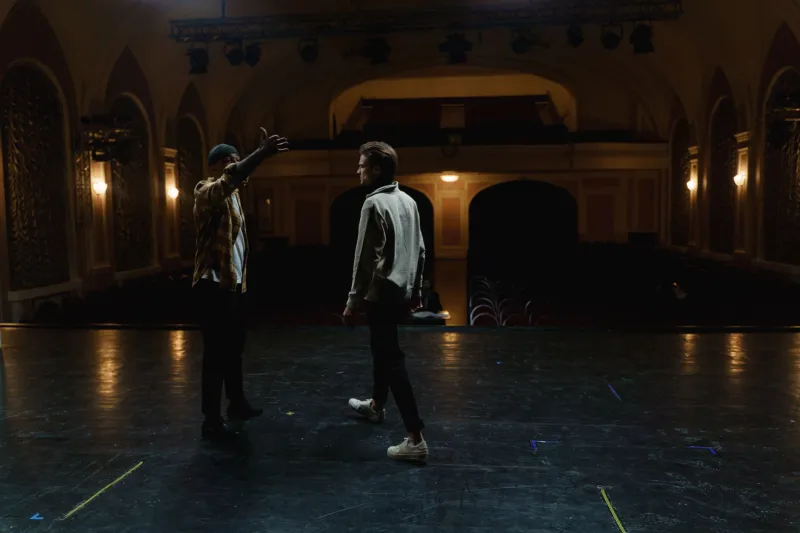
No lights. No costumes. House still cold, the stage door bell still buzzing. A few performers in leggings and a hoodie, a stage manager with a clipboard, a fight captain with a roll of spike tape, and a very specific negotiation with gravity.
This is the ritual we're here to talk about.
The entry nobody photographs
A fight call is the pre-show run-through of everything in a production that involves physical risk: slaps, punches, chokes, grabs, falls, lifts, knife work, sword passes, and — since intimacy coordination became a standard part of UK rehearsal rooms — the choreographed moments of closeness that sit alongside them.
It typically happens between twenty and forty-five minutes before the half, depending on the size of the show and the number of sequences. A big commercial musical with weapon work and multiple lifts might need a full half-hour and a dedicated fight captain running sections. A two-hander in a 90-seat room above a pub might do ten minutes of marks and a couple of slow-motion slaps — but it still happens, and it still gets logged.
What it isn't is a warm-up in the stretching sense, although there's usually some of that too. It's a check: are the marks where we left them, is the floor where we left it, is everyone's body in the state it was in yesterday, and does the illusion still read from row K.
The last one matters more than you'd think. Stage violence is a magic trick with a very short shelf life. A slap that looked brutal in week two can look like two people high-fiving by week five, and a fall that once made an audience gasp can drift into something that reads as a stumble. The fight call is where that drift gets corrected.
Slow it down and say it out loud
A good fight call is run at maybe half speed, sometimes quarter. Fight captains call the sequence aloud — "grab, turn, slap, release, step back" — and performers say their own cues back. It sounds faintly ridiculous if you wander in mid-flow. It's also the single most effective safety tool in the building, because the moment someone can't say the sequence out loud is usually the moment they've stopped thinking about it and started coasting.
Cues get re-confirmed. Distances get measured, usually with a foot rather than an eye. Hands get placed on shoulders, hips, throats and wrists with the specific precision of people who have agreed in advance exactly where they're allowed to be. Nothing is improvised at this stage of the day; improvisation is a rehearsal-room luxury, never a show-time one.
Knaps, spit and the business of believability
A lot of the craft is sound. The knap — the offstage clap, snap or slapping of one's own body that sells a punch — is rehearsed as carefully as the punch itself. So is breath. A crowd believes a hit because of the exhale that follows it, and because of the way the receiver's head moves a beat later than you'd expect.
Then there's the unglamorous inventory. Jewellery off, rings checked, nails checked, hair pins accounted for. Swords and knives inspected and confirmed blunt, then marked so nobody swaps a show weapon for a rehearsal one. Blood packs and sweat and floor texture all doing their own quiet arithmetic. Fake blood makes a laminate floor treacherous in a way that mirrors a fight captain's nightmares.
And yes, occasionally someone is asked to spit on the floor. It's a friction test. The stage management team would rather know at 6.55pm than at 8.20pm.
Lifts, falls and the person catching you
Falls are where the discipline is most visible. Mats get laid and dressed under a rug or a piece of set. The landing area gets walked, not glanced at. The performer doing the fall confirms their exit route, their roll, and the fact that the person breaking their fall — and there is always somebody breaking it — knows exactly where their hands go.
Lifts are a two-way contract. The lifted performer has to be able to say "stop" at any point without it being a drama, and the lifting performer has to be honest about the state of their back, their shoulder, their sleep. Fight calls are one of the few places in a theatre where a performer can say "not today" about their own body and the whole schedule reshapes around it.
That's not softness. It's the opposite. It's the reason a show can run eight times a week for months without a serious injury.
Consent has a rehearsal too
Intimacy calls work on the same rhythm. Choreography is re-confirmed gesture by gesture, the boundaries agreed in the rehearsal room are restated, and the option to adjust is genuinely open rather than theoretically open. In the UK, intimacy coordinators, intimacy directors and trained chaperones now sit alongside fight directors on a growing number of productions — subsidised, commercial and fringe — and the practical result backstage is a shared vocabulary: agreed touch, agreed duration, agreed exit.
It's worth saying that the UK's fight community has been pushing this culture for years. Organisations like the British Academy of Stage and Screen Combat train performers and directors in safe practice, and most producing houses now expect risk assessments, near-miss reporting and a named person responsible for physical sequences. The paperwork is dull. The absence of incidents is not.
New venue, new maths
Touring companies have the sharpest version of this ritual. Every stage is a different size, with a different rake, a different floor, a different distance from the top of the show to the back wall. A fight that worked in Salford can put somebody's shoulder into a fly bar in Canterbury.
So the first fight call in a new venue is longer, quieter and more paranoid than usual. Marks get re-spiked. Drop-offs get re-measured. The person doing the backflip — or the modest stumble, depending on the show — walks the space five times before anyone claps a rhythm.
Thirty-five minutes of trust
Then it's over. Notes given, tape pressed down, mats hidden, water bottles filled. House open, audience in, lights down.
And at 8.20pm, two people will have a row on stage that looks like it might genuinely kick off, and a thousand strangers will flinch in unison. Nobody will clap for the fight call. Nobody will know it happened. But every believable punch, every stomach-dropping fall, every near-miss that stops your breath for a second — all of it was agreed at five o'clock, when the seats were empty and the only audience was a stage manager with a clipboard.
Backstage, that's just Tuesday.